
You were losing fat. Consistently, steadily — a kilo here, half a kilo there. Progress was happening. Then one week, nothing. Then another week, nothing. The scale shows the same number it showed three weeks ago.
You didn't change anything. You're still hitting your calories. Still training. So what the hell is going on?
This is a plateau. And it happens to almost everyone who loses a meaningful amount of fat. It's not a mystery, it's not bad luck, and it doesn't mean your metabolism is damaged. It means your body is doing exactly what it's designed to do — and you need to understand that before you can fix it.
- A plateau means your body has adapted — it's not a sign something is broken, it's a sign something worked
- The most common cause is not a broken metabolism — it's calorie creep and underestimated intake
- Your TDEE drops as you lose weight — what got you here won't keep getting you there
- NEAT (non-exercise activity) drops significantly during a cut — and most people don't notice
- The fix is almost never "eat less" — it's usually track better, move more, or take a strategic break
- Two weeks without movement on the scale is not a plateau — it's normal fluctuation. Four weeks is a plateau.
What a Fat Loss Plateau Actually Is (And Isn't)
First, let's be precise about what we're talking about. A plateau is four or more weeks with no net change in body weight or body composition, while following your intended diet and training plan.
It is not: two or three weeks of the scale being flat. Week-to-week weight fluctuations of 1–2kg are completely normal and caused by water retention, glycogen levels, digestive content, hormonal cycles, and sodium intake. If you weigh yourself daily, you will see this noise — don't mistake it for a plateau.
A plateau is also not evidence of a broken metabolism. The concept of "metabolic damage" — where your metabolism permanently slows to the point it can't lose fat — is not supported by the evidence. What does happen is metabolic adaptation, which is real, measurable, and fully reversible. That's what we're actually dealing with.
The Real Reasons Your Progress Stalled
There are several distinct mechanisms behind a fat loss plateau. Most people have more than one happening at once.
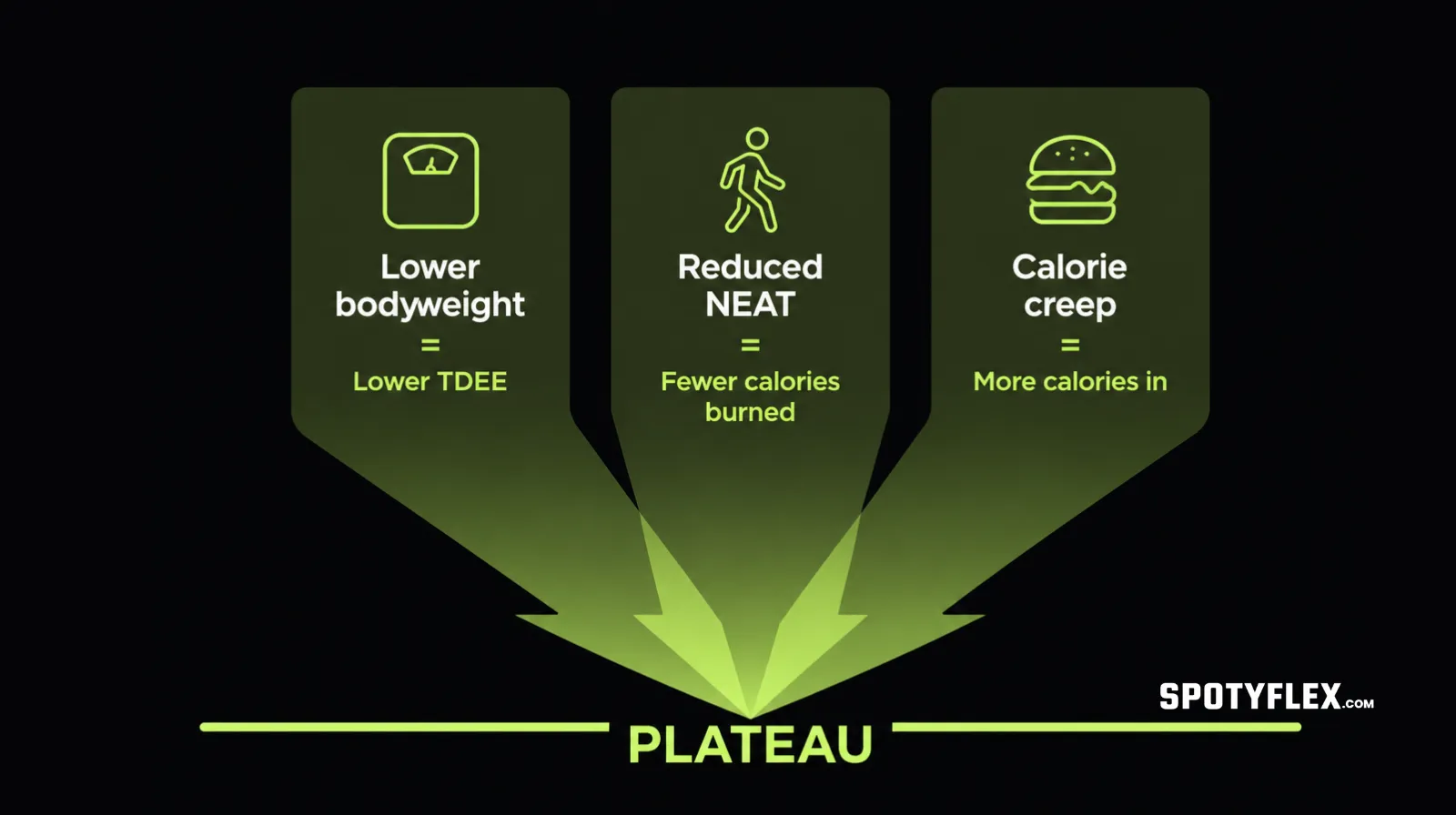
Your TDEE dropped with your bodyweight
When you weigh less, you burn fewer calories doing the same things. A lighter body requires less energy to move, to maintain temperature, to keep organs running. This is simple physics, and it's unavoidable. The calorie deficit that worked at 90kg may no longer be a deficit at 78kg — the same intake is now maintenance, not a cut.
NEAT crashes without you noticing
NEAT (Non-Exercise Activity Thermogenesis) is all the calories you burn outside the gym — walking, fidgeting, taking the stairs, gesturing when you talk. During a prolonged caloric deficit, your body unconsciously reduces NEAT to conserve energy. You sit slightly more. You take slightly fewer steps. You fidget less. Each change is tiny, but together they can erase hundreds of calories per day from your total expenditure — without you ever consciously deciding to move less.
Calorie creep — the silent plateau killer
Most people's tracking accuracy degrades over time. Oils aren't weighed. Bites and tastes aren't logged. Portion sizes drift upward. A couple of "underestimated" meals per week can easily add 300–500 calories without registering. After months of dieting, what started as an accurate 500kcal deficit has become a 100kcal deficit — barely enough to show movement on the scale.
Hormonal adaptation
A sustained caloric deficit affects hormones in ways that actively resist further fat loss. Leptin (the satiety hormone) drops, increasing hunger. Ghrelin (the hunger hormone) rises. Thyroid output can decrease slightly, reducing metabolic rate further. These aren't permanent changes — they normalize when you eat at maintenance — but during a cut, they're working against you, which is why sustained deficits get progressively harder the longer they go on.
How to Diagnose Your Specific Plateau
Before you change anything, figure out which type of plateau you're actually in. The fix depends entirely on the cause.
| Plateau type | Signs | Most likely fix |
|---|---|---|
| Calorie creep plateau Most common |
Tracking has gotten looser over time; eating out more; eyeballing portions | Two-week tracking reset — weigh everything, log every bite, recalibrate |
| TDEE-drop plateau | Accurate tracking, genuinely in a deficit, but no longer losing — especially after 10kg+ of fat loss | Recalculate TDEE at current bodyweight, adjust calories down by 100–150kcal |
| NEAT crash plateau | Feeling sluggish, less motivated to move, step count has drifted down | Increase structured daily steps (target 8,000–10,000/day), add zone 2 cardio |
| Hormonal / fatigue plateau | Been dieting for 4+ months straight, feeling tired and flat, performance in gym dropping | Diet break at maintenance for 1–2 weeks before resuming the cut |
The 6 Proven Ways to Break Through
These aren't random tips. Each one addresses a specific mechanism behind fat loss stalls. Use the diagnosis from Section 03 to pick your starting point.

The Diet Break Strategy — When and How to Use It
This is the one most people resist the most — and the one that often works best for long-term plateaus.
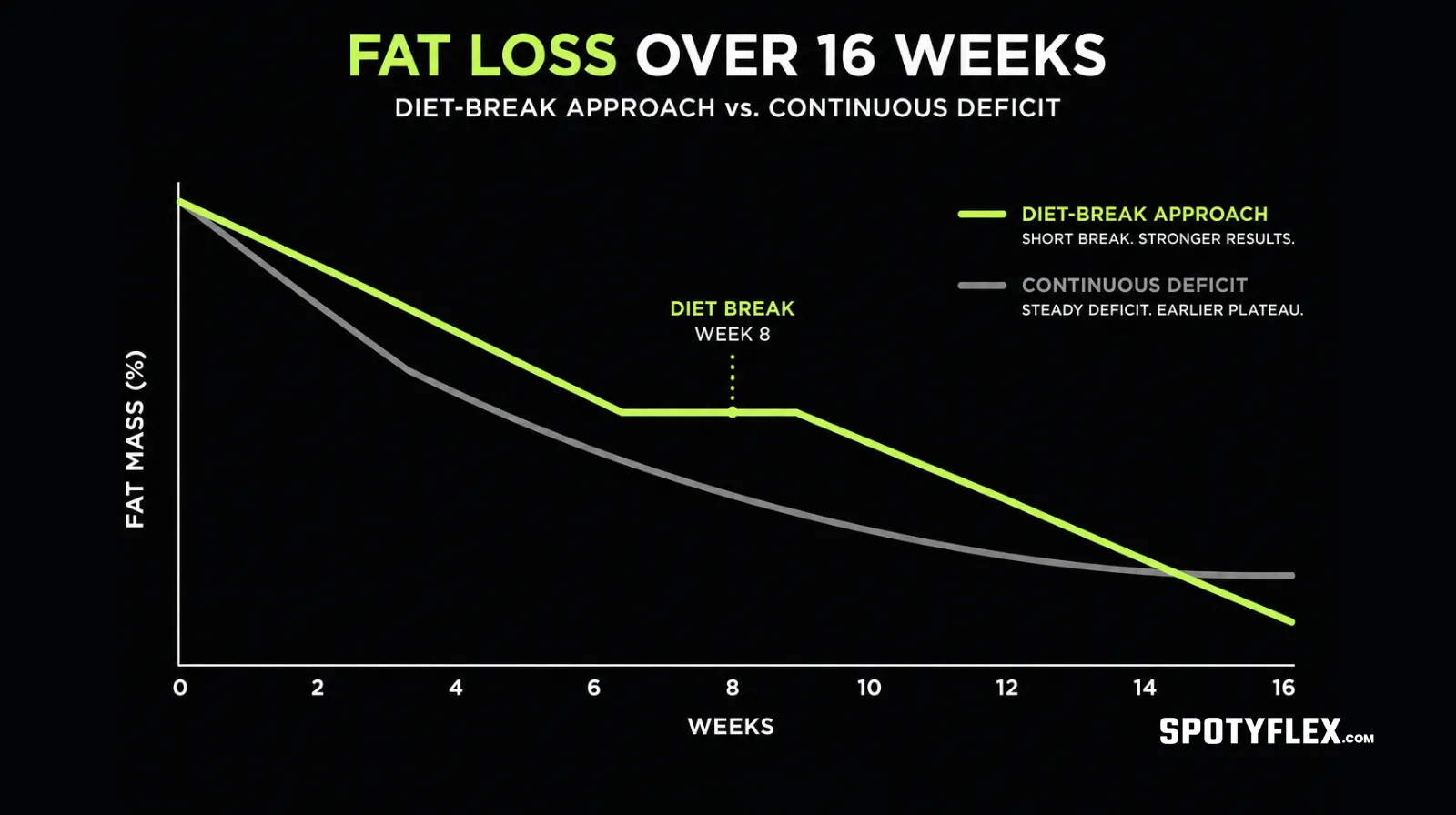
A diet break is a planned period of eating at maintenance calories (not a surplus, not a deficit) for 1–2 weeks in the middle of a fat loss phase. It's not quitting. It's a strategic reset.
What it actually does
After months in a deficit, leptin levels drop, NEAT has been suppressed, and hunger hormones are elevated. Eating at maintenance for 1–2 weeks partially restores leptin, normalizes hunger signaling, and lets your nervous system recover from the chronic stress of restriction. When you return to the deficit, your body responds again — fat loss resumes.
Research suggests diet breaks can produce similar or better fat loss results over 16 weeks compared to continuous dieting, with significantly better muscle retention and adherence. It's not a setback — it's a longer-game strategy.
How to run a diet break correctly
Eat at your current TDEE — not your starting TDEE, your current one. That means maintenance calories for someone at your current bodyweight, not what you were eating before the cut. Keep training exactly as you are. Don't use it as an excuse to eat junk — maintenance is maintenance, not a binge. After 1–2 weeks, return to a modest deficit (300–400kcal below maintenance) and reassess every 4 weeks.
Mistakes That Keep You Stuck
Most plateau-breaking advice focuses on what to add. Equally important is what to stop doing — because some common reactions to a plateau actively make things worse.

Slashing calories dramatically
The instinct is to cut more when fat loss stalls. But going from a 500kcal deficit to an 800+ kcal deficit accelerates muscle loss, tanks energy, crashes hunger hormones further, and makes adherence nearly impossible. A small, targeted reduction of 100–150kcal is all that's needed — not a crash.
Piling on more cardio
Adding two extra cardio sessions to an already-stressed system raises cortisol, impairs recovery, increases hunger, and rarely produces the results people expect. If cardio is already high, adding more usually hurts more than it helps. Walk more instead — it burns calories without the hormonal cost.
Changing too many things at once
If you cut calories, add cardio, change your training split, and stop eating carbs all in the same week — you won't know what worked. And when things go wrong, you won't know what caused it. Make one change, wait two weeks, assess, then adjust again.
Panic-weighing daily and reacting to every fluctuation
Checking your weight every day and reacting emotionally to each number is one of the fastest ways to derail a cut. Use weekly averages. Accept that the scale will go up after high-sodium meals, a heavy training day, or a bad night's sleep — and that none of those numbers represent real fat gain.
A fat loss plateau is not a sign of failure — it's a sign your body successfully adapted to what you were doing. The solution is almost never to do more or eat less. It's to diagnose the actual cause, make one targeted adjustment, and give it enough time to work. Most plateaus are broken within two weeks of accurate tracking. The rest respond to a TDEE recalculation or a strategic diet break.
The Bottom Line
Plateaus happen to everyone who loses a meaningful amount of fat. They're caused by a falling TDEE, suppressed NEAT, calorie creep, and hormonal adaptation — usually a combination of all four. They are not permanent and they are not evidence of a broken metabolism.
Start with a two-week tracking reset before changing anything else. Recalculate your TDEE at your current bodyweight. Increase daily steps. Add zone 2 cardio if needed. If you've been dieting for more than 12–16 weeks continuously, consider a structured 1–2 week diet break before pushing further.
What you should avoid: dramatic calorie cuts, stacking cardio on an already-stressed system, and making too many changes at once. One change, two weeks, assess. That's the process.
This article is based on peer-reviewed research and established nutrition science. Sources listed for transparency and verification.
- Leibel RL, Rosenbaum M, Hirsch J. (1995). Changes in energy expenditure resulting from altered body weight. New England Journal of Medicine, 332(10), 621–628. pubmed.ncbi.nlm.nih.gov
- Levine JA. (2002). Non-exercise activity thermogenesis (NEAT). Best Practice & Research Clinical Endocrinology & Metabolism, 16(4), 679–702. pubmed.ncbi.nlm.nih.gov
- Dhurandhar EJ, et al. (2015). The accuracy of self-reported energy intake as a dietary assessment method. International Journal of Obesity, 39(7), 1069–1079. pubmed.ncbi.nlm.nih.gov
- Byrne NM, et al. (2018). Intermittent energy restriction improves weight loss efficiency in obese men: the MATADOR study. International Journal of Obesity, 42(2), 129–138. (diet break evidence) pubmed.ncbi.nlm.nih.gov
- Tremblay A, Simoneau JA, Bouchard C. (1994). Impact of exercise intensity on body fatness and skeletal muscle metabolism. Metabolism, 43(7), 814–818. pubmed.ncbi.nlm.nih.gov
- Müller MJ, Bosy-Westphal A. (2013). Adaptive thermogenesis with weight loss in humans. Obesity, 21(2), 218–228. pubmed.ncbi.nlm.nih.gov
Younes is the founder and content creator behind SpotyFlex — a fitness blog built on the principle that real training knowledge shouldn't be buried under bro-science and filler. He covers strength training, nutrition, and recovery with a focus on what the research actually supports. When he's not writing or building the platform, he's in the gym applying it.