



Before we dive into the exact numbers and habits, here’s the simple truth: fat loss is not just about the time you spend in the gym. Most of the calories you burn are decided by how you move during the rest of your day, and that’s what NEAT is all about.
- NEAT stands for Non-Exercise Activity Thermogenesis — all movement that isn't structured exercise.
- NEAT can vary by up to 2,000 calories per day between people of similar size and weight.
- For most people, NEAT accounts for a larger share of daily calorie burn than gym workouts.
- When you diet, your body unconsciously suppresses NEAT — a key reason fat loss stalls.
- Walking more, standing more, and staying active throughout the day are the highest-leverage NEAT habits.
What NEAT Actually Is
Your body burns calories in four ways. Your BMR (basal metabolic rate) keeps your organs running while you sleep. The thermic effect of food burns calories digesting what you eat. Exercise activity thermogenesis (EAT) is your structured workouts. And then there's NEAT — everything else.
Non-Exercise Activity Thermogenesis covers every calorie burned through movement that isn't planned exercise: walking to your car, typing, cooking, pacing while on the phone, shifting your weight in your chair, even fidgeting. It's the background noise of physical activity that runs constantly — and it adds up to far more than most people realize.
A gym session typically lasts 45–90 minutes. NEAT operates for the other 22+ hours of your day. Even if your workouts are intense, they're a small fraction of your total daily movement potential.
NEAT was first formally studied and named by Dr. James Levine at the Mayo Clinic. His research found that sedentary individuals sit for up to 2.5 hours more per day than active individuals — and that difference alone could account for 350+ extra calories burned daily, without a single gym session.

The four components of Total Daily Energy Expenditure (TDEE) — and where NEAT fits in.
Why NEAT Beats the Gym for Calorie Burn
Here's the number that changes how most people think about their calorie deficit:
To put that in perspective: a solid 60-minute lifting session burns somewhere between 250–400 calories for most people. A highly active NEAT lifestyle can burn 5–8 times that — just by moving naturally throughout the day.
This is why two people can follow the exact same training program and produce wildly different fat loss results. The one losing more weight isn't necessarily training harder — they're moving more outside the gym. They walk to meetings instead of driving. They pace on calls. They take stairs. They stand at their desk. None of it feels like exercise, but all of it burns calories.
A construction worker and an office worker of the same weight and gym schedule can differ by 1,500+ calories per day purely through NEAT. The construction worker isn't trying to burn calories — the movement is just built into their day. Understanding this is the real unlock for sustainable fat loss.
This also explains why fat loss is harder for desk-workers. It's not just about motivation or willpower. Modern sedentary jobs have structurally removed NEAT from daily life, and no amount of gym time fully compensates for that.
Why Your NEAT Drops When You Diet
Here's where it gets uncomfortable: when you cut calories, your body fights back — and one of its primary weapons is suppressing your NEAT.
This is called adaptive thermogenesis. As you eat less, your nervous system unconsciously signals your body to move less. You sit more. You fidget less. You take the elevator without thinking about it. You stop pacing. None of this is conscious — it's your body trying to protect itself from a perceived energy shortage.
Studies show NEAT can drop by 200–500+ calories per day during a sustained calorie deficit — before your metabolic rate even changes. This means your deficit is eroding from the inside. You didn't change anything, but you're burning less.
This is one of the main reasons people hit fat loss plateaus. They assume their metabolism has "broken." It hasn't. Their NEAT has quietly contracted. The fix isn't to eat even less — it's to consciously protect and restore your NEAT through the habits below.
Tracking daily steps is one of the most practical ways to monitor this. If you were averaging 8,000 steps and that number has drifted to 5,000 without any lifestyle change, your body's NEAT suppression mechanism is at work.
How to Increase Your NEAT Daily
NEAT isn't a special workout protocol. You don't schedule it. You build it into the texture of your day. These are the highest-leverage habits:
8,000–10,000 steps per day is the sweet spot for most people. Each 1,000 steps above your baseline burns roughly 40–50 additional calories. Walking is the most underrated fat loss tool in existence. It's low-impact, appetite-suppressing, and compounds every day.
Standing burns approximately 50 more calories per hour than sitting. That's over 400 extra calories across an 8-hour workday. A standing desk or simply standing during calls adds up fast.
Replace your seated lunch break with a 15-minute walk. Pace during phone calls. Walk to a colleague's desk instead of messaging them. These feel trivial in isolation — they're not.
These are clichés because they work. Eliminating every convenience movement from your day has real cumulative caloric cost. Add them back strategically and you'll see it in your step count.
Set a reminder. Stand up, walk to another room, do 10 bodyweight squats. Even short 2–5 minute movement breaks every hour improve both NEAT and metabolic markers. Sitting for 8 hours straight crushes your daily calorie burn even if you trained that morning.
Gardening, cleaning, cooking, carrying groceries — these are all NEAT. Don't outsource everything. Do them actively. Put on music and move while you do them. It sounds almost too simple, but this is genuinely how active people stay active.
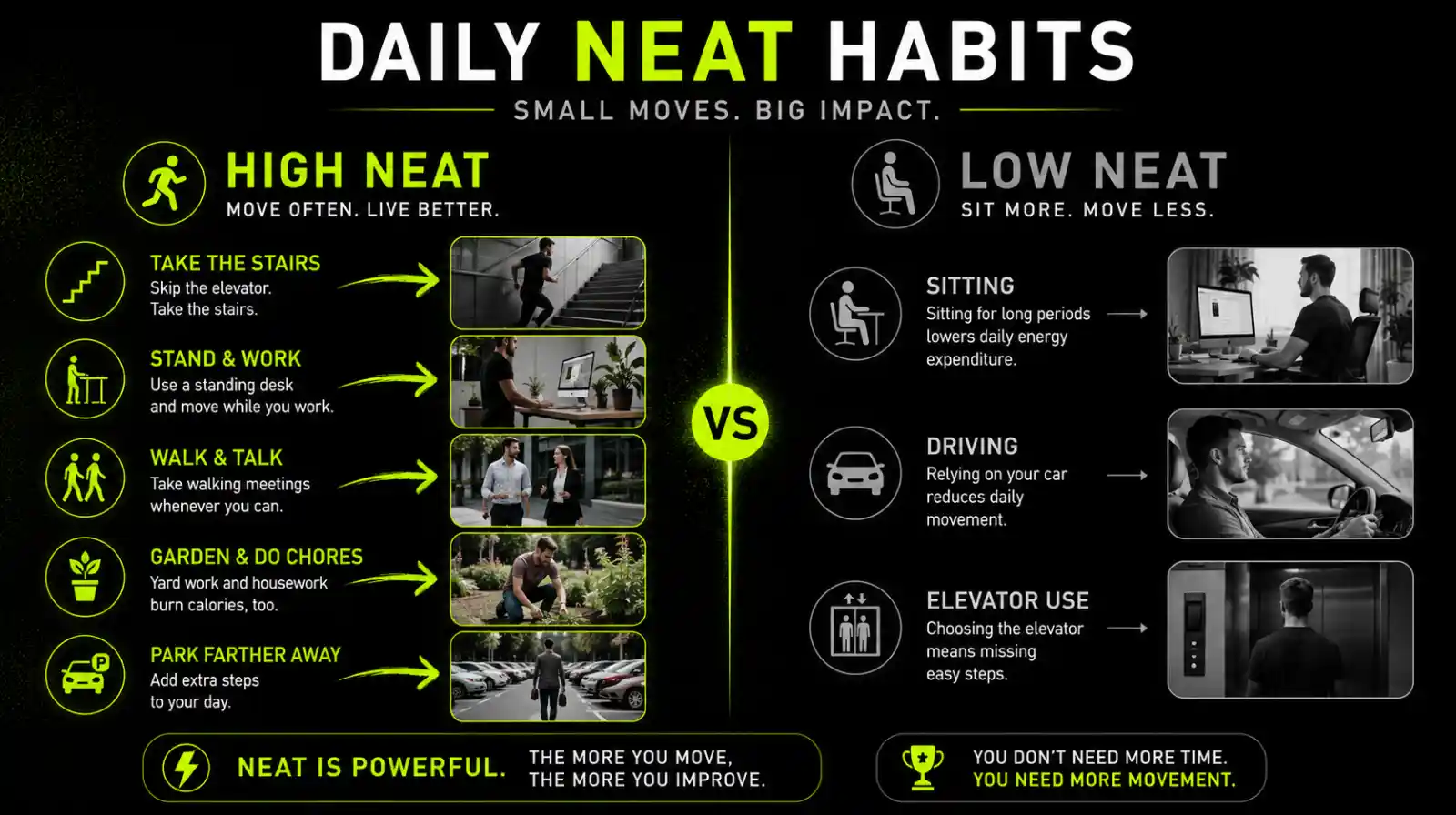
Small movement habits — stairs, walking meetings, standing — compound across an entire day.
NEAT vs Exercise — Do You Still Need to Train?
Yes — and here's why the two aren't competing.
Exercise does things NEAT can't. Progressive strength training builds and preserves muscle mass, which directly raises your resting metabolic rate. It produces hormonal adaptations that improve insulin sensitivity, recovery, and body composition. Cardio improves cardiovascular capacity and can create a meaningful acute calorie deficit.
- Builds and preserves muscle
- Raises resting metabolic rate
- Produces hormonal adaptations
- Improves strength and performance
- Creates significant acute calorie burn
- The other 22 hours of your day
- Countering sedentary baseline
- NEAT suppression during a cut
- Long-term daily calorie accumulation
- Metabolic adaptation from dieting
The most effective fat loss strategy isn't to choose between exercise and NEAT — it's to stack them. Train consistently to build muscle and burn calories acutely. Then use NEAT to keep your total daily expenditure high throughout the rest of the day. Use your TDEE calculator to understand how these variables interact with your actual calorie targets.
Think of it this way: your workout is the investment. Your NEAT is the compound interest.
If you're training hard but not losing fat, the answer is rarely to train harder. It's more likely to look at the 22 hours outside the gym — and ask how active you actually are. That's where the real deficit lives.
FAQ
- Levine JA, et al. Interindividual variation in posture allocation: possible role in human obesity. Science. 2005;307(5709):584–586. doi:10.1126/science.1106561
- Levine JA. Non-exercise activity thermogenesis (NEAT). Best Pract Res Clin Endocrinol Metab. 2002;16(4):679–702. doi:10.1053/beem.2002.0227
- Rosenbaum M, Leibel RL. Adaptive thermogenesis in humans. Int J Obes. 2010;34(S1):S47–S55. doi:10.1038/ijo.2010.184
- Buckley JP, et al. Standing-based office work shows encouraging signs of attenuating post-lunch dips in energy expenditure. Occup Environ Med. 2014;71(2):109–111. doi:10.1136/oemed-2013-101823
- Dunstan DW, et al. Breaking up prolonged sitting reduces postprandial glucose and insulin responses. Diabetes Care. 2012;35(5):976–983. doi:10.2337/dc11-1931

/1.webp)
