



Most people who "lose weight" don't actually lose much fat — they lose weight, and a good chunk of that number on the scale is muscle. That's how you end up lighter but somehow softer, with less strength in the gym and the same stubborn look in the mirror. The good news: the research on this is clear, and the fix isn't complicated. It just means doing four things on purpose instead of by accident.
TL;DR
- Keep your deficit moderate — aim to lose about 0.5–1% of bodyweight per week, not 2-3%.
- Eat roughly 1.6–2.4 g of protein per kg of bodyweight every day, spread across 3-5 meals.
- Keep lifting heavy and progressively — resistance training is what tells your body "keep the muscle."
- Protect your sleep. Short sleep during a diet shifts losses away from fat and toward lean tissue.
- Use walking/NEAT for most of your extra calorie burn; save high-intensity cardio for a few sessions a week.
- Take a diet break or refeed every 6-10 weeks if you're cutting long-term — it protects muscle and sanity.
01Why You Lose Muscle When Cutting Calories
When you eat in a deficit, your body doesn't know the difference between "I'm doing a planned fat loss phase" and "food is scarce, survive." Without a signal telling it otherwise, it will pull energy from the cheapest, fastest sources available — and muscle tissue is metabolically expensive to maintain, so some of it gets sacrificed alongside fat.
In practice, research on hypoenergetic (calorie-restricted) diets shows that roughly 20-30% of the weight lost can come from lean body mass rather than fat, especially when the deficit is aggressive, protein is low, or training stops. The three signals that tell your body "keep the muscle, I still need it" are: enough protein, enough resistance training, and a deficit that isn't brutal. Take any one of those away and lean mass loss creeps up.
02How Big Should Your Calorie Deficit Be?
Bigger deficit doesn't mean better results — past a certain point it just means more muscle loss for the same amount of fat loss. A study on elite athletes compared a slow weight-loss rate (about 0.7% of bodyweight per week) to a fast one (1.4% per week) over several weeks of resistance training. The slower group lost essentially the same amount of fat but came out with noticeably better lean mass retention and performance than the faster group.
If you're already lean and resistance-trained, lean toward the smaller end of that deficit — trained bodies are worse at sparing muscle in a deficit than untrained ones, so they need every other variable (protein, training, sleep) dialed in tighter.
03Protein: The Non-Negotiable
If you only fix one thing from this article, fix this one. Protein is the single most studied variable for preserving lean mass during a cut, and the data is consistent: more protein, less muscle lost, even at the exact same rate of fat loss.
In a controlled trial on resistance-trained athletes, one group ate around 1.0 g/kg of protein during a two-week aggressive cut while another ate around 2.3 g/kg. Both groups lost a similar amount of total weight, but the higher-protein group lost dramatically less lean body mass. A separate randomized trial combining intense exercise with a calorie deficit found that bumping protein from 1.2 g/kg to 2.4 g/kg didn't just preserve muscle — the high-protein group actually gained lean mass while losing fat, in the same energy deficit.
What that means for your plate
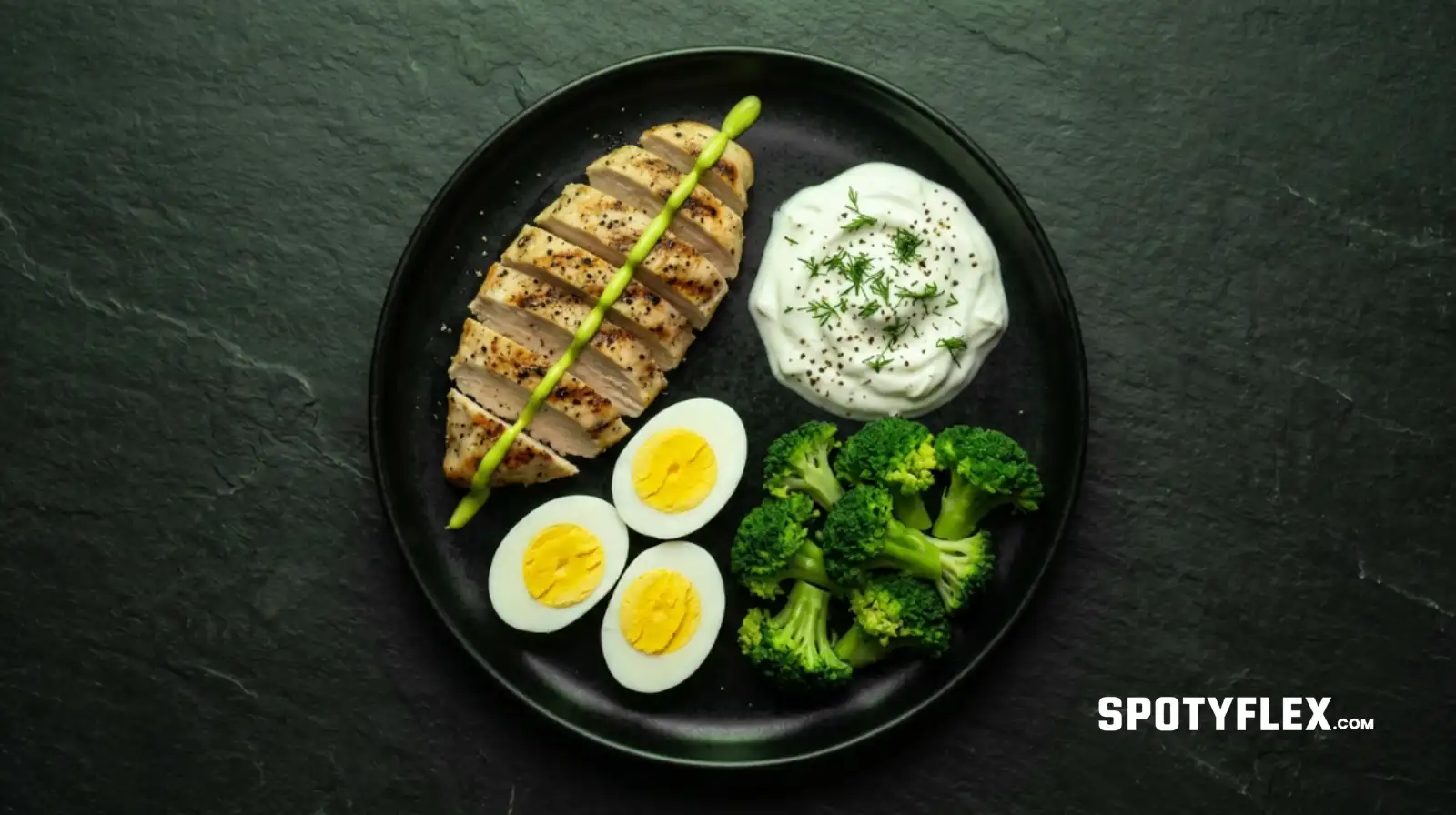
- Target 1.6-2.4 g of protein per kg of bodyweight per day (more if you're already very lean).
- Spread it across 3-5 meals rather than one or two huge servings — distribution matters for muscle protein synthesis.
- Prioritize protein first when planning meals; let carbs and fats fill the remaining calories.
- A meal with roughly 0.4-0.5 g/kg of protein before and after training appears to help, though total daily intake matters more than exact timing.
04Keep Lifting Heavy — Don't Switch to Cardio-Only
This is where a lot of cuts quietly go wrong: people start "eating less and moving more" and the "moving more" turns into long cardio sessions while lifting gets deprioritized. That's backwards. Resistance training is the strongest signal your body has for "this tissue is still in use, don't touch it."
- Keep training at or near your normal training volume and intensity — a deficit is not the time to drop to light, high-rep "toning" workouts.
- Prioritize compound lifts (squat, hinge, press, row, pull) that recruit the most muscle mass per session.
- Track your numbers. If your lifts are dropping fast week over week, your deficit is probably too aggressive or recovery is lacking.
- 3-5 resistance sessions per week is the range used in most of the studies showing strong lean-mass retention during a cut.
Cardio still has a place — it's just not the lever you pull to "save" a diet that's too aggressive. More on balancing it in the cardio section below.
05Sleep and Recovery: The Variable Everyone Skips
A controlled crossover study put overweight adults on the same moderate calorie deficit for two weeks, once with 8.5 hours of sleep opportunity and once with only 5.5 hours. Total weight loss was nearly identical between the two conditions — but the composition of that weight loss wasn't. With curtailed sleep, the proportion of weight lost as fat dropped sharply, and a much larger share came from lean body mass instead. Participants also reported feeling hungrier on less sleep.
In other words: short sleep doesn't necessarily stop the scale from moving, but it changes what is moving — pushing losses away from fat and toward muscle, while also working against you through hunger and recovery.
- Protect 7-9 hours of sleep opportunity nightly, especially during a cut.
- Keep a consistent sleep/wake schedule — your training recovery and hunger hormones both depend on it.
- Treat sleep as a training variable, not an afterthought. It's free, and skipping it costs you muscle.

06How Much Cardio Is Too Much?
Cardio doesn't directly "burn muscle," but stacking a lot of high-intensity or high-volume cardio on top of an already aggressive calorie deficit and heavy lifting can push your total recovery demand past what your body can handle — and that's when lean mass starts to slip.
| Type | Best use during a cut | Watch out for |
|---|---|---|
| Walking / NEAT | Main lever for extra daily burn | Almost no downside — increase first |
| Low-intensity steady cardio | 2-3x/week, supports recovery | Doesn't add much if NEAT is already high |
| High-intensity intervals | 1-2x/week, on non-leg-heavy lifting days | Stacks fatigue fast in a deficit |
If your strength is dropping, your sleep is suffering, or you're constantly sore, that's your sign to dial cardio back before touching your lifting or your protein.
07Refeeds and Diet Breaks
Long, uninterrupted cuts increase the risk of dropping training intensity, sleep quality, and adherence — all of which make muscle loss more likely. Building in periodic higher-calorie days (refeeds) or a full 1-2 week diet break every 6-10 weeks of cutting gives your body, hormones, and motivation a reset before continuing.
- A refeed day brings calories up near maintenance, mostly through carbohydrates, for a day.
- A diet break is 1-2 weeks at maintenance calories before resuming the deficit.
- Neither is required for short cuts (under 8 weeks), but both become more valuable the longer and leaner the cut gets.
085 Mistakes That Quietly Eat Your Muscle
- Cutting too fast. Losing more than ~1% of bodyweight per week almost guarantees a bigger share comes from muscle.
- Under-eating protein to "save calories." Protein is the most expendable place to cut calories from — and the worst one.
- Dropping training volume because you're tired. Some fatigue is normal in a deficit; cutting your lifting in half is not the fix.
- Sacrificing sleep for extra cardio sessions or late-night work. You're trading fat loss for muscle loss without realizing it.
- Never taking a break. Months of uninterrupted dieting wears down adherence, training quality, and recovery all at once.
09Sample Day of Eating (~75 kg, Moderate Deficit)
This is one example structure, not a prescription — adjust portions to your own calorie target and food preferences.
| Meal | Example | Protein |
|---|---|---|
| Breakfast | 3 eggs + 1 cup Greek yogurt + berries | ~40 g |
| Lunch | 200 g chicken breast + rice + vegetables | ~45 g |
| Pre/post workout | Whey protein shake + banana | ~25 g |
| Dinner | 200 g lean beef or fish + potatoes + salad | ~40 g |
That structure lands around 150 g of protein, which covers the 2 g/kg target for a 75 kg lifter — the rest of the day's calories come from carbs and fats to hit your overall deficit.
10FAQ
Can I build muscle while losing fat?
To a degree, yes — especially if you're new to lifting, returning after a break, or carrying extra body fat. Research on higher-protein, resistance-trained groups in a deficit has shown small lean mass gains alongside fat loss. Experienced, already-lean lifters should aim more realistically for "preserve," not "build."
Is it better to lose weight slowly or quickly?
Slowly, if muscle retention matters to you. Studies comparing weight-loss rates in trained individuals consistently show better lean mass and performance outcomes with a moderate, gradual approach.
Do I need to do cardio to lose fat?
No — a calorie deficit is what drives fat loss, and that can come from diet alone. Cardio (and especially walking) just makes hitting that deficit easier and supports cardiovascular health along the way.
How do I know if I'm losing muscle instead of fat?
Watch your strength numbers. If your main lifts are dropping noticeably week over week (beyond normal day-to-day fluctuation), that's a strong sign your deficit, protein, or recovery needs adjusting.
11Sources
-
Mettler S, Mitchell N, Tipton KD. Increased protein intake reduces lean body mass loss during weight loss in athletes. Med Sci Sports Exerc. 2010;42(2):326-337.
pubmed.ncbi.nlm.nih.gov/19927027 -
Longland TM, Oikawa SY, Mitchell CJ, Devries MC, Phillips SM. Higher compared with lower dietary protein during an energy deficit combined with intense exercise promotes greater lean mass gain and fat mass loss: a randomized trial. Am J Clin Nutr. 2016;103(3):738-746.
pubmed.ncbi.nlm.nih.gov/26817506 -
Garthe I, Raastad T, Refsnes PE, Koivisto A, Sundgot-Borgen J. Effect of two different weight-loss rates on body composition and strength and power-related performance in elite athletes. Int J Sport Nutr Exerc Metab. 2011;21(2):97-104.
pubmed.ncbi.nlm.nih.gov/21896944 -
Helms ER, Aragon AA, Fitschen PJ. Evidence-based recommendations for natural bodybuilding contest preparation: nutrition and supplementation. J Int Soc Sports Nutr. 2014;11:20.
pubmed.ncbi.nlm.nih.gov/24864135 -
Nedeltcheva AV, Kilkus JM, Imperial J, Schoeller DA, Penev PD. Insufficient sleep undermines dietary efforts to reduce adiposity. Ann Intern Med. 2010;153(7):435-441.
pubmed.ncbi.nlm.nih.gov/20921542
This article is for general educational purposes and isn't a substitute for personalized advice from a doctor, registered dietitian, or qualified coach — especially if you have an existing health condition.

/1.webp)
