



You've been training consistently for weeks. The sessions have been solid. Then one Tuesday you walk into the gym, load the bar with your usual weight, and it feels like it weighs twice as much. Your joints ache. Your head isn't in it. Your numbers are going backwards.
Most people react to this by pushing harder, thinking they're just having a bad week. That's the wrong call. What your body is telling you is that it needs a deload — and ignoring that signal is one of the most reliable ways to stall your progress, pick up an injury, or burn out entirely.
This guide explains exactly what a deload week is, the science behind why it works, how to know when you need one, and how to structure it so you come back stronger instead of just taking a random week off.
TL;DR — For Busy People
- A deload is a planned week of reduced training volume or intensity — not a rest week, not skipping the gym
- It allows your nervous system, joints, and connective tissue to recover from accumulated fatigue
- Most intermediate lifters benefit from a deload every 4–8 weeks; advanced lifters every 3–6 weeks
- The most practical method: keep the same exercises, cut sets by 40–50%, keep weight moderate
- You will not lose muscle in one week — the fear of deloading is bigger than the cost of skipping it
What a Deload Week Actually Is
A deload is a planned, intentional reduction in training stress for a set period — typically one week. You still train. You still go to the gym. You just train at a fraction of your normal volume or intensity, giving your body the space it needs to fully absorb and recover from the accumulated load of previous weeks.
The key word is planned. A deload is not a lazy week where motivation ran out. It's a deliberate training tool, built into your programme in advance, the same way you plan your heavy sessions. The athletes and lifters who deload consistently are the ones still making progress year after year — because they understand that muscle is built during recovery, not during training.
A deload is not the same as taking a full week off. Complete rest has its place after injury or illness, but a deload keeps your movement patterns sharp, maintains training habits, and actively flushes fatigue without the detraining that can come with total inactivity.
Why Your Body Needs It: The Science of Fatigue Accumulation

Every training session creates fatigue — in your muscles, your central nervous system (CNS), your tendons and ligaments, and your joints. In the short term, this is exactly what you want. Fatigue is part of the adaptation signal. But fatigue also masks your fitness. When you're fatigued, you perform below your actual capability — you feel weaker even though your underlying fitness has increased.
The problem arrives when fatigue accumulates faster than you can recover from it between sessions. Over weeks of consistent hard training, this builds up into what sport scientists call functional overreaching — a state where performance drops, motivation dips, sleep quality degrades, and the risk of injury rises sharply.
A deload week gives accumulated fatigue time to dissipate while your fitness stays intact. When you return to full training the following week, your performance often jumps noticeably — because the fitness that was being masked by fatigue is now visible. This is sometimes called a supercompensation effect, and it's why many lifters hit personal bests in the week after a deload.
How to Know When You Need a Deload
Some people deload on a fixed schedule regardless of how they feel. Others use autoregulation — reading their body's signals and deloading reactively. Both approaches work. But to use the reactive approach effectively, you need to know what to look for.
Here are the clearest signals that accumulated fatigue is overdue for a reset:
The 3 Ways to Structure a Deload Week
There's no single correct way to deload. The method you use depends on your training experience, what kind of fatigue you're carrying, and your personal preference. Here are the three main approaches.
Volume Deload Most Popular
Keep the same exercises and roughly the same weights. Cut your total sets by 40–50%. If you normally do 4 sets of squats, do 2. If you do 5 exercises per session, do 3. Intensity (how heavy you lift) stays moderate — around 60–70% of your usual working weight. This is the most widely recommended method for intermediate lifters and the easiest to implement without overthinking.
Intensity Deload
Keep the same number of sets and exercises, but drop the weight to 50–60% of your usual load. You maintain the same movement patterns and volume, just at a significantly lighter load. This works better for athletes who need to maintain neuromuscular patterns but whose joints need a break from heavy loading. Less popular than volume deloads because training lighter for a full week can feel mentally frustrating.
Active Recovery Deload
Swap the gym entirely for low-intensity movement — walking, cycling, swimming, mobility work, yoga. No structured lifting at all. Best reserved for periods of genuine physical burnout, post-competition recovery, or when dealing with a minor injury that needs space. Not a substitute for a proper deload if you intend to return to progressive overload — you'll lose some of the pattern sharpness that volume or intensity deloads preserve.
Recommended Starting Point
If you've never deliberately deloaded before: go with the volume deload. Same exercises, same weight range, half the sets. Train for 45–50 minutes instead of your usual session length. Keep your nutrition the same — do not slash calories during a deload week.
Deload Week: What Changes and What Stays the Same
| Variable | Normal Week | Deload Week |
|---|---|---|
| Sets per exercise | 3–5 working sets | 2 working sets (volume deload) |
| Weight / load | 75–85% of 1RM | 60–70% of 1RM — never grinding reps |
| Exercises | Full programme | Keep your main lifts, drop most accessories |
| Training frequency | 4–5 sessions/week | 3–4 sessions — or same frequency, shorter sessions |
| Rep ranges | 6–12 for hypertrophy | Same range, but stop 4–5 reps short of failure |
| Nutrition | Maintenance or surplus | Unchanged — same calories and protein |
| Sleep target | 7–9 hours | Prioritise 8–9 hours — this is when the real recovery happens |
| Cardio | As programmed | Keep light cardio, reduce or drop HIIT |
What Not to Do During a Deload
Don't slash your calories
A common mistake: you're training less so you eat less. This is the opposite of what recovery needs. Your body is using this week to repair connective tissue, replenish glycogen, and restore hormonal balance. It needs fuel to do all of that. Keep your protein at the same level — 1.6–2.2g per kg of bodyweight — and don't intentionally create a large calorie deficit.
Don't turn it into a full rest week by default
Some movement during a deload is better than none. Complete inactivity for a week removes the neural stimulus that keeps your movement patterns sharp. You'll feel stiffer, your first session back will feel rougher, and you won't get the full benefit of the structured reduction in fatigue that a proper deload provides.
Don't train to failure
The point of a deload is to reduce accumulated stress — not add to it. Stop every set with 4–5 reps still in the tank. No grinding, no PRs, no "just one more." The whole week should feel almost suspiciously comfortable. That discomfort with going easy is normal — it doesn't mean you're doing it wrong.
Don't panic about losing muscle
Research consistently shows that meaningful muscle loss does not begin until after 10–14 days of complete inactivity. One week of reduced training will not cost you muscle tissue. What you might notice is a slight reduction in the "pump" look as glycogen stores normalise — this is temporary and reverses within a few days of returning to full training.
How to Programme Your Deloads
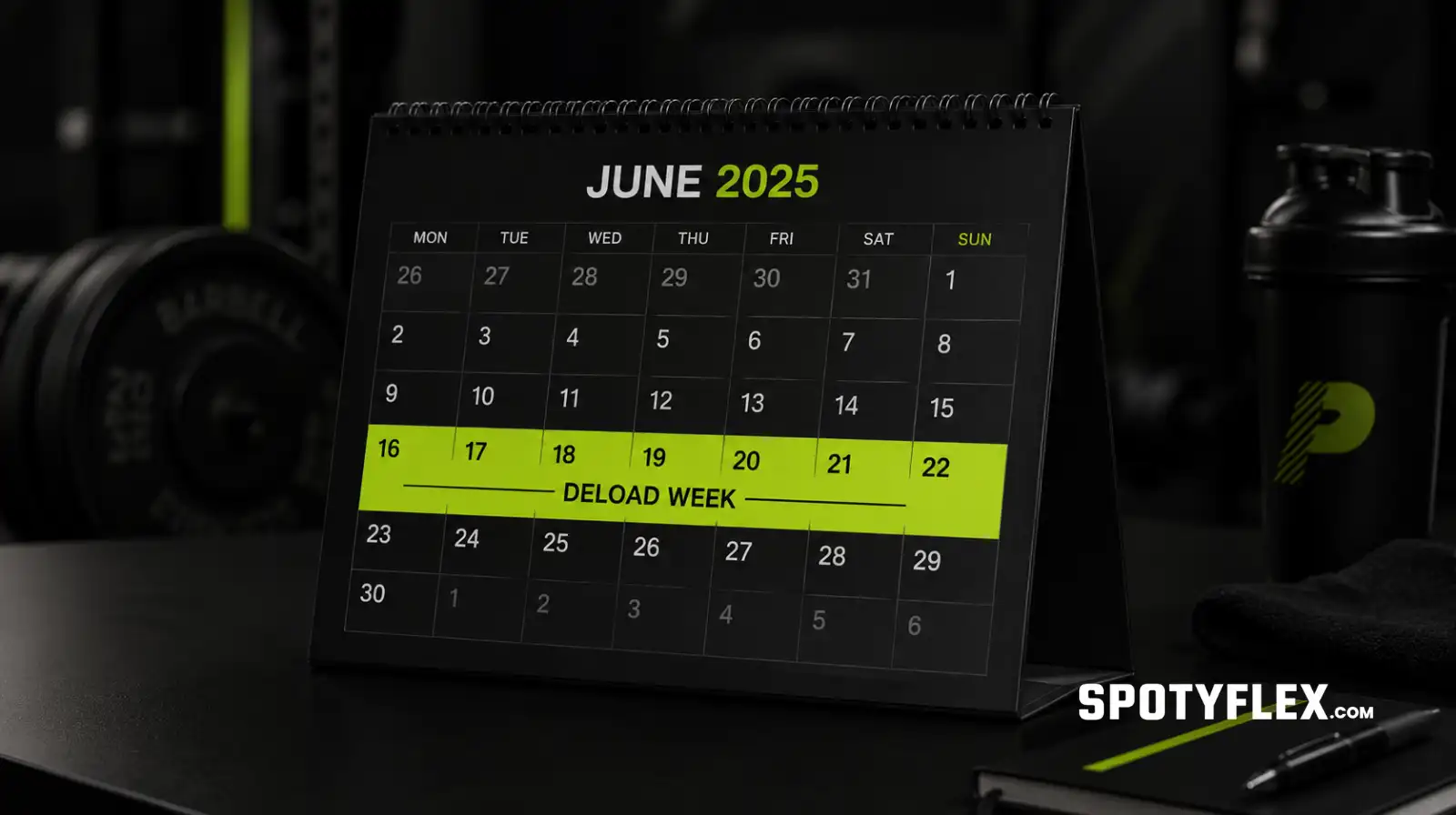
There are two schools of thought on when to deload: scheduled and autoregulated. Neither is strictly better — it depends on your personality and experience level.
Scheduled Deloads
Build a deload into your training calendar every 4–8 weeks, regardless of how you feel. This is the more reliable approach for most people because it removes the temptation to push through fatigue signals and "wait until you really need it." By the time most people feel like they need a deload, they've already been overreaching for two weeks. Scheduling it in advance prevents that.
A simple structure: 3 weeks hard, 1 week deload. Repeat. Or 6 weeks hard, 1 week deload for intermediate and advanced lifters who've built up better recovery capacity.
Autoregulated Deloads
Deload when the signals appear — from the checklist above. This requires more self-awareness and honesty, but works well for experienced lifters who know their body well and can distinguish between genuine fatigue and just having a bad session. The risk: most people are optimists about their own recovery and delay deloading until they're already in a hole.
If you're in your first two years of training, use scheduled deloads — every 4–6 weeks. If you've been training for 2+ years and can honestly read your own fatigue signals, switch to autoregulated. Either way, if you've never deliberately deloaded and have been training consistently for more than 6 weeks — start this week.
The Bottom Line
Deloading is not optional if you want to train hard long-term. It's the mechanism that lets you keep applying progressive overload month after month without grinding your body into a state where progress becomes impossible.
The best lifters in the gym — the ones making consistent progress year after year — are not the ones who never take it easy. They're the ones who know exactly when to push and exactly when to back off. A deload week is the scheduled back-off that makes the next push possible.
Plan your next deload now. Put it in your calendar. Treat it with the same seriousness as your heaviest training day — because it's just as important to your results.
Know Your Training Load
Use the SpotyFlex 1RM Calculator to track where your strength actually sits — and set realistic targets for when you return from your deload.
Use the 1RM Calculator →Sources & Further Reading
- Meeusen R et al. Prevention, diagnosis and treatment of the overtraining syndrome. Eur J Sport Sci. 2013. PubMed ↗
- Aubry A et al. Functional overreaching: the key to peak performance during the taper? Med Sci Sports Exerc. 2014. PubMed ↗
- Bosquet L et al. Effects of tapering on performance: a meta-analysis. Med Sci Sports Exerc. 2007. PubMed ↗
- Häkkinen K et al. Neuromuscular adaptations during concurrent strength and endurance training. J Appl Physiol. 2003. PubMed ↗
This article is for educational and informational purposes only and does not constitute medical advice. Consult a qualified healthcare professional before starting or modifying any exercise programme. Some links may be affiliate links — see our disclosure policy.

/1.webp)
