When I first walked into the gym, I had no idea what I was doing. I'd jump from machine to machine, do a few curls, maybe some chest presses, and leave feeling like I'd trained but with zero structure. It took a while to realize that the program matters as much as the effort. This is the split that finally made things click — and it works whether it's your first week or you're coming back after months off.
Why This Split Works
The structure here is called a 4-day muscle group split. You train four days a week, each day targeting a specific set of muscles that work well together, and you rest the other three. That's it. No complicated periodization, no daily grind.
The logic behind grouping muscles isn't random. Research shows that when you pair muscles that naturally assist each other during compound movements — like back and biceps — you get better stimulus with less total fatigue per session.[1] Your biceps already help during every back pull anyway. Might as well train them together and give them a full rest before the next session.
The Weekly Schedule
Here's how the week looks. Wednesday and the weekend give your central nervous system time to recover properly.
Each session runs roughly 50 to 70 minutes including warm-up. That's enough to stimulate growth without destroying your recovery. Every exercise follows a 3 sets × 8–12 reps scheme — the classic hypertrophy range backed by decades of research.[3]
Day 1 — Back & Biceps

Back is the biggest muscle group in your upper body and the one most beginners undervalue. Training it first in the week — when you're fresh — is intentional. Your biceps act as secondary movers on every pull, so they get pre-fatigued by the compound work, then finished off with isolation.
| # | Exercise | Sets | Reps | Rest |
|---|---|---|---|---|
| 1 | Barbell Deadlift | 3 | 6–8 | 2–3 min |
| 2 | Lat Pulldown (wide grip) | 3 | 10–12 | 90 sec |
| 3 | Barbell Bent-Over Row | 3 | 8–10 | 90 sec |
| 4 | Seated Cable Row | 3 | 10–12 | 90 sec |
| 5 | Barbell Bicep Curl | 3 | 10–12 | 60 sec |
| 6 | Hammer Curl (dumbbells) | 3 | 10–12 | 60 sec |
- 1 Barbell Deadlift
- 2 Lat Pulldown (wide grip)
- 3 Barbell Bent-Over Row
- 4 Seated Cable Row
- 5 Barbell Bicep Curl
- 6 Hammer Curl (dumbbells)
Why these exercises?
The deadlift is non-negotiable. It recruits more total muscle mass than almost any other movement and triggers a significant hormonal response.[4] The lat pulldown teaches you the pulling pattern before you're strong enough for pull-ups, and the bent-over row hits the mid-back thickness that makes you look trained. Finish with curls — both supinated (palms up) for the long head of the bicep, and hammer grip for the brachialis, which adds width to the arm.
Day 2 — Chest & Triceps
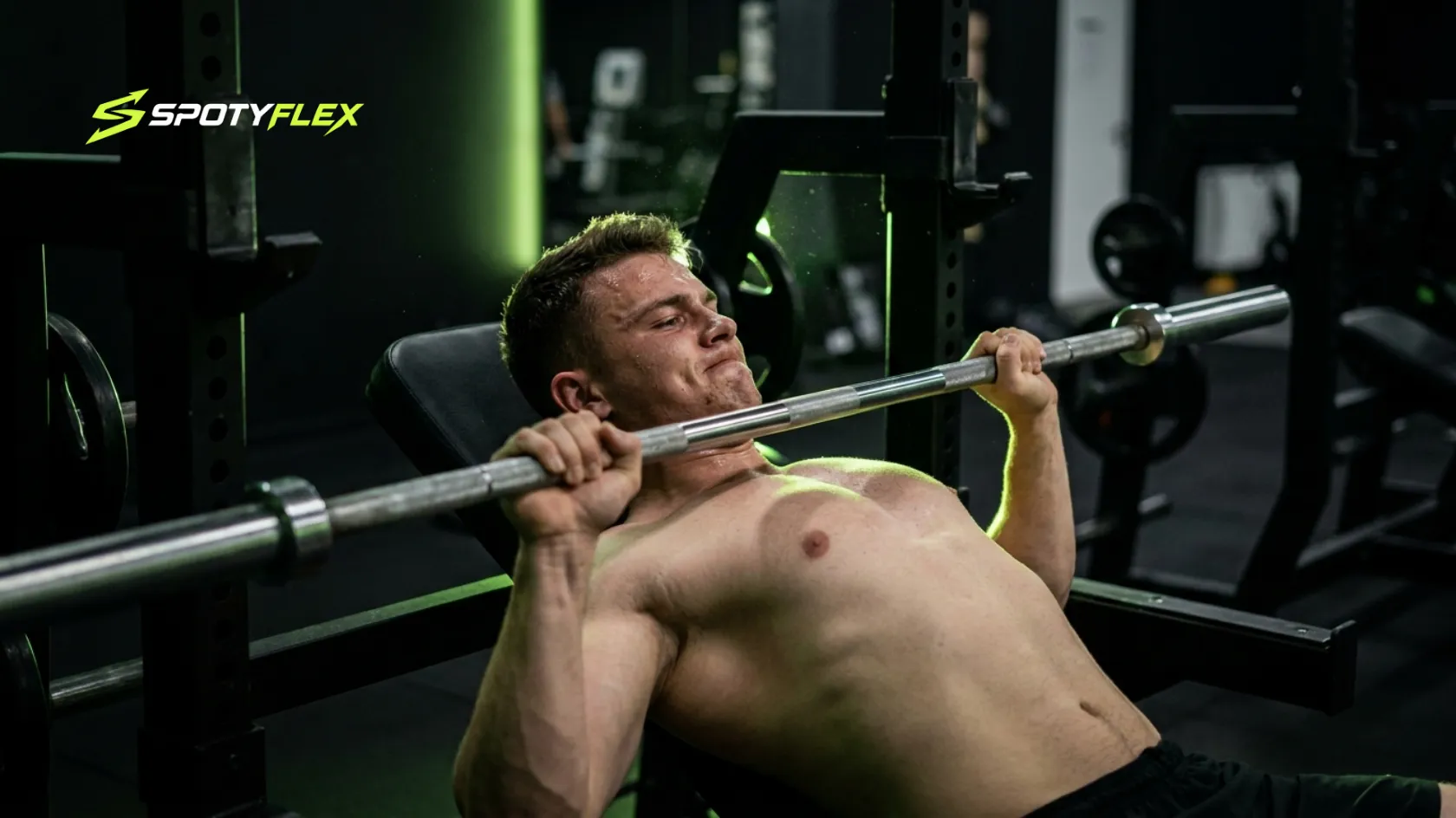
Chest and triceps is the most intuitive pairing in any gym program. Every pressing movement — flat, incline, decline — uses your triceps as a major synergist. By the time you get to your tricep isolation work, they're already warm and partially fatigued, which makes the isolation more efficient.
| # | Exercise | Sets | Reps | Rest |
|---|---|---|---|---|
| 1 | Flat Barbell Bench Press | 3 | 8–10 | 2 min |
| 2 | Incline Dumbbell Press | 3 | 10–12 | 90 sec |
| 3 | Cable Chest Fly (low to high) | 3 | 12–15 | 60 sec |
| 4 | Dips (chest-forward lean) | 3 | 8–12 | 90 sec |
| 5 | Tricep Rope Pushdown | 3 | 12–15 | 60 sec |
| 6 | Overhead Dumbbell Extension | 3 | 10–12 | 60 sec |
- 1 Flat Barbell Bench Press
- 2 Incline Dumbbell Press
- 3 Cable Chest Fly (low to high)
- 4 Dips (chest-forward lean)
- 5 Tricep Rope Pushdown
- 6 Overhead Dumbbell Extension
Why these exercises?
The flat bench press is the foundation — it builds overall chest mass and pressing strength. Incline press targets the clavicular head of the pectoralis major, the upper chest region most people neglect.[5] The cable fly keeps tension on the chest throughout the full range of motion, something dumbbells lose at the top. Dips with a forward lean shift emphasis to the lower chest. The tricep work — rope pushdown for lateral head, overhead extension for long head — ensures balanced arm development.
Day 3 — Shoulders, Traps & Forearms

Shoulders are what create the V-taper — that wide-shoulder, narrow-waist silhouette that reads as "athletic" from any angle. Traps and forearms get tacked onto this day because they're smaller muscle groups that need direct work but don't warrant their own session.
| # | Exercise | Sets | Reps | Rest |
|---|---|---|---|---|
| 1 | Barbell Overhead Press (OHP) | 3 | 8–10 | 2 min |
| 2 | Dumbbell Lateral Raise | 3 | 12–15 | 60 sec |
| 3 | Dumbbell Front Raise | 3 | 12–15 | 60 sec |
| 4 | Rear Delt Fly (cables or bent-over) | 3 | 12–15 | 60 sec |
| 5 | Barbell Shrug | 3 | 12–15 | 60 sec |
| 6 | Dumbbell Wrist Curl (forearms) | 3 | 15–20 | 45 sec |
| 7 | Reverse Wrist Curl (forearms) | 3 | 15–20 | 45 sec |
- 1 Barbell Overhead Press (OHP)
- 2 Dumbbell Lateral Raise
- 3 Dumbbell Front Raise
- 4 Rear Delt Fly (cables or bent-over)
- 5 Barbell Shrug
- 6 Dumbbell Wrist Curl (forearms)
- 7 Reverse Wrist Curl (forearms)
Why these exercises?
The overhead press is the king of shoulder movements — it works all three deltoid heads and has strong carryover to overall upper body strength.[6] Lateral raises are the most direct path to wider-looking shoulders by isolating the medial deltoid. Rear delt work is critical and almost always neglected by beginners — weak rear delts lead to shoulder imbalances and eventually pain. Shrugs for trap thickness, and both wrist curl directions for balanced forearm development.
Day 4 — Legs

Leg day is the one most beginners skip. Don't. Your legs make up roughly half your muscle mass, and training them triggers a systemic anabolic response that benefits your entire body.[7] Skipping legs doesn't just leave you with an imbalanced physique — it leaves a massive training stimulus on the table.
| # | Exercise | Sets | Reps | Rest |
|---|---|---|---|---|
| 1 | Barbell Back Squat | 3 | 8–10 | 2–3 min |
| 2 | Romanian Deadlift (RDL) | 3 | 10–12 | 90 sec |
| 3 | Leg Press | 3 | 10–12 | 90 sec |
| 4 | Walking Lunges (dumbbells) | 3 | 10 each leg | 90 sec |
| 5 | Leg Curl (machine) | 3 | 10–12 | 60 sec |
| 6 | Standing Calf Raise | 3 | 15–20 | 60 sec |
- 1 Barbell Back Squat
- 2 Romanian Deadlift (RDL)
- 3 Leg Press
- 4 Walking Lunges (dumbbells)
- 5 Leg Curl (machine)
- 6 Standing Calf Raise
Why these exercises?
The barbell squat is the single best lower-body movement — it develops quad strength, hip stability, and core control simultaneously.[8] The Romanian deadlift is the best hamstring exercise for beginners — it teaches hip hinging under load and builds the posterior chain. Leg press lets you load volume onto the quads without as much CNS demand as squats. Lunges train single-leg stability. Leg curls isolate the hamstrings in a shortened position (which the RDL doesn't fully cover), and calf raises are the most neglected lower-body exercise that most people regret ignoring for years.
How to Progress Week by Week

The program is only as effective as the progression you apply to it. Progressive overload — gradually increasing the challenge on your muscles over time — is the single most important principle in resistance training.[9]
Here's how to do it without overcomplicating it:
The Simple Progression Rule
When you hit the top of the rep range (e.g., 12 reps) with good form on all 3 sets, add 2.5 kg to barbell lifts and 2 kg to dumbbell movements the following week. If you can't reach the bottom of the rep range, keep the weight the same until you can.
What Beginners Get Wrong With This Kind of Program
Ego loading
Using weight you can't control just to lift heavier. The muscle doesn't see the number on the plate — it only responds to mechanical tension and metabolic stress.[10] Learn the movement first. Load it second.
Skipping the warm-up
Before any session, spend 5–8 minutes on light cardio and 2 warm-up sets per main lift (at 40–60% of your working weight). This isn't optional. Cold muscles under heavy load are the most common path to injury for beginners.
Inconsistency
Four weeks of this program done consistently beats twelve weeks of on-again off-again training every time. The beginner phase is when your body is the most responsive to training stimulus — don't waste it.
Not eating enough
You cannot build muscle in a significant calorie deficit. If you're starting out and want to see real size changes, you need to be eating at or slightly above your maintenance calories with sufficient protein — at least 1.6g per kg of bodyweight per day.[11]

How Long Should You Run This Program?
Run it for at least 12 weeks before changing anything. Most beginners switch programs too early — right when the adaptation is actually starting to compound. Stick with it, keep adding weight, and let the results come.
After 12 weeks, if progress has stalled, consider increasing volume (an extra set per exercise) or adjusting the rep ranges before switching to a completely different program.
References
- Schoenfeld BJ, Ogborn D, Krieger JW. Effects of Resistance Training Frequency on Measures of Muscle Hypertrophy: A Systematic Review and Meta-Analysis. Sports Med. 2016;46(11):1689–1697. PubMed
- Schoenfeld BJ, Ratamess NA, Peterson MD, et al. Influence of Resistance Training Frequency on Muscular Adaptations in Well-Trained Men. J Strength Cond Res. 2015;29(7):1821–1829. PubMed
- American College of Sports Medicine. Progression Models in Resistance Training for Healthy Adults. Med Sci Sports Exerc. 2009;41(3):687–708. PubMed
- Kraemer WJ, Ratamess NA, French DN. Resistance training for health and performance. Curr Sports Med Rep. 2002;1(3):165–171. PubMed
- Lauver JD, Cayot TE, Scheuermann BW. Influence of bench angle on upper extremity muscular activation during bench press exercise. Eur J Sport Sci. 2016;16(3):309–316. PubMed
- Saeterbakken AH, Fimland MS. Effects of body position and loading modality on muscle activity and strength in shoulder presses. J Strength Cond Res. 2013;27(7):1824–1831. PubMed
- Kraemer WJ, Ratamess NA. Hormonal responses and adaptations to resistance exercise and training. Sports Med. 2005;35(4):339–361. PubMed
- Escamilla RF. Knee biomechanics of the dynamic squat exercise. Med Sci Sports Exerc. 2001;33(1):127–141. PubMed
- Kraemer WJ, Ratamess NA. Fundamentals of resistance training: progression and exercise prescription. Med Sci Sports Exerc. 2004;36(4):674–688. PubMed
- Schoenfeld BJ. The mechanisms of muscle hypertrophy and their application to resistance training. J Strength Cond Res. 2010;24(10):2857–2872. PubMed
- Morton RW, Murphy KT, McKellar SR, et al. A systematic review, meta-analysis and meta-regression of the effect of protein supplementation on resistance training-induced gains in muscle mass and strength. Br J Sports Med. 2018;52(6):376–384. PubMed
/1.webp)