
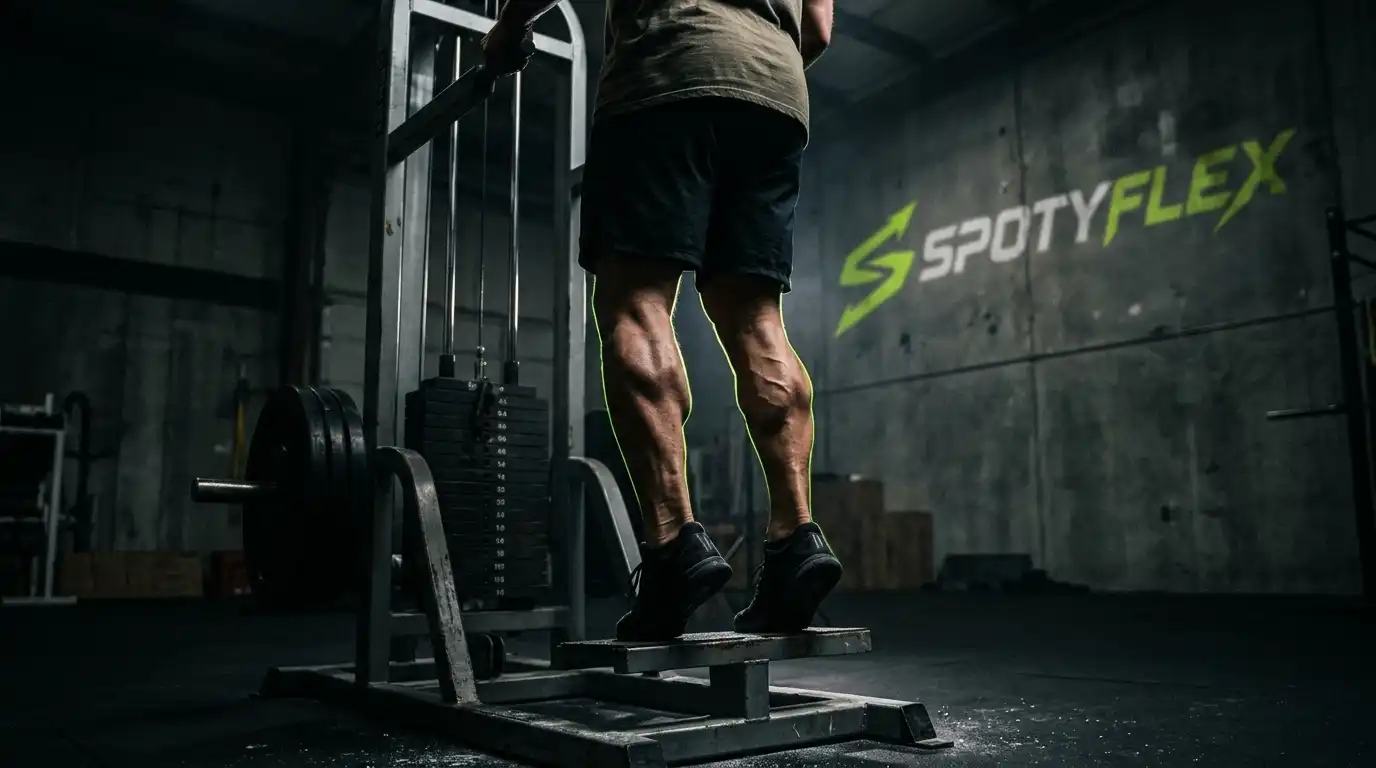

For about two years my calf routine was ten quick raises at the end of leg day, usually while I checked my phone between sets. I never missed a rep and my calves never changed. I decided it was genetics. Some of it probably is, but most of it was me bouncing through a tiny piece of the movement and calling it training.
At a glance
- Who it’s for: beginner to intermediate lifters with gym access
- Days per week: 1 to 2 calf sessions
- Session length: about 30 to 35 minutes including warm-up
- Equipment: standing calf raise machine (or Smith machine), leg press, a step and a dumbbell, seated calf raise machine
- Not for you if: you have Achilles or ankle pain, a recent calf or lower leg injury, or a medical condition affecting your legs or circulation. See a doctor or physiotherapist first.
Table of contents
Weekly schedule
Calves are small, recover fast and don’t need a whole day to themselves, so I run this as a short stand-alone session. Start with one calf day a week for the first two weeks. From week three, add the second one.
Each session is 10 working sets. Reps run from 8 up to 20 depending on the exercise, and rest is 1 to 2 minutes. That’s a short session, which is the point: I’d rather you do it properly twice a week than skip a long one.
Why this approach works
Calves have a reputation for being stubborn, and the research agrees they’re harder to grow than most muscles.1 That’s a reason to train them with more care, not a reason to give up.
In a 12-week study, 14 untrained adults trained one leg with standing calf raises and the other with seated ones. The standing leg grew clearly more in both gastrocnemius muscles (the visible part of the calf), for example 12.4% versus 1.7% in the lateral one. The soleus, the flatter muscle underneath, grew about the same either way.1 So standing raises are the base of this plan.
Range matters too. In an 8-week study of 42 young women, calf raises done only in the bottom, stretched half of the movement produced the biggest gain in the medial gastrocnemius (15.2%), compared with 7.3% for full-range reps, although the gap to full range wasn’t statistically clear.2 That’s why one exercise here uses stretched-position reps, and why I stopped bouncing.
Then there’s volume. A meta-analysis of 15 studies found that more weekly sets tended to mean more muscle growth.3 That’s why the plan builds up to two sessions instead of one.
These studies are small, mostly in untrained people, and ran 8 to 12 weeks. The volume paper looked at muscle in general, not calves specifically. They point in a direction. They don’t promise your result.
The calf day
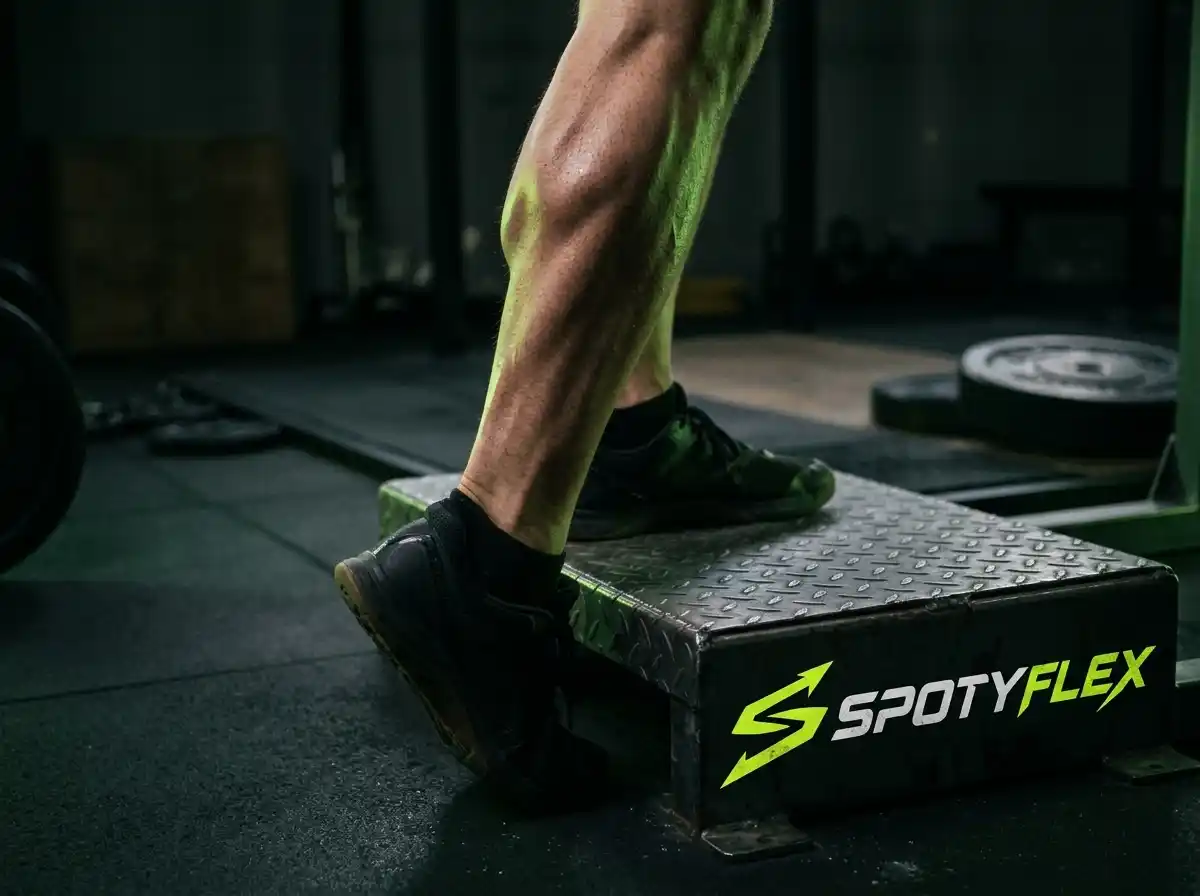
Every exercise here works the same two muscles from a slightly different angle: the gastrocnemius and the soleus. Together they make the calf. I put the heavy standing raise first while I’m fresh, then move to higher reps where the stretch does the work.
Calf dayStretch, pause, squeeze
| # | Exercise | Sets | Reps | Rest |
|---|---|---|---|---|
| Standing calf raiseMachine or Smith machine. Full stretch, 1 to 2 second pause at the bottom. | 3 | 8 to 12 | 2 min | |
| Leg press calf raise, bottom halfStay in the lower, stretched half of the range. Don’t lock your knees hard. | 3 | 12 to 20 | 90 sec | |
| Single-leg calf raise on a stepOne dumbbell in the hand on the working side, other hand on a rack for balance. | 2 | 10 to 15 each | 60 sec | |
| Seated calf raiseSlow and smooth. Optional finisher for variety. | 2 | 12 to 15 | 60 sec |
Warm up with 5 minutes of easy walking, then one light set of standing raises before your first working set. Numbers are a starting point, not a prescription.
Why these exercises?
The standing raise leads because it grew the gastrocnemius most in the study I mentioned.1 Exercise 2 uses the stretched range that did well in the 8-week trial, which used sets of 15 to 20 reps to failure on a leg press style machine.2 The single-leg version evens out any left to right difference and lets a light dumbbell go a long way.
The seated raise is the one I’d call optional. In the study the soleus grew about the same with standing or seated raises,1 so I keep it for variety and for days when the standing machine is taken, not because it beats the others.
Count it out: about 2 seconds up, a short squeeze at the top, 2 seconds down, then a real pause in the stretch. The 12-week study used a similar controlled 2 second up and 2 second down tempo.1 If your heels are bouncing, the weight is too heavy or you’re rushing.
Progression
Progressive overload just means asking a little more of your calves over time. For calves, small steps work best because the weight on a machine can jump a lot between pins. I link my full explanation in the progressive overload guide.
The simple rule
Stay at one weight until you hit the top of the rep range on every set with a full stretch and a pause. Then add the smallest jump you can. The 12-week study did something similar, adding load in small steps once participants completed everything cleanly.1 If reps drop below the bottom of the range, go back down a step.
Once you’ve got a few months behind you, you can try one extra trick on exercise 1: after your last full rep, keep going with small reps in the stretched half. One 10-week study in untrained men found slightly more medial gastrocnemius growth in the leg that did this (9.6% versus 6.7%), but it’s one study with modest certainty, so treat it as optional.4
Write down weight, reps and whether you paused in the stretch. A calf raise “feels the same” every week unless you have the numbers.
Common beginner mistakes
Bouncing out of the bottom
I did this for years. The bounce lets the tendon do the work and skips the stretch. Pause for a second and let the calf take the load.
Cutting the range short
Heavy weight and a tiny movement feels strong but trains very little. Drop the weight until you can go all the way down and all the way up.
Treating them as an afterthought
Ten tired reps at the end of leg day isn’t much of a signal. Give calves their own short session, when you’re fresh.
Pushing through ankle or Achilles pain
Muscle burn is fine. Sharp or lingering pain at the back of the ankle, or a hot, swollen, tender calf, is not. Stop and see a doctor or physiotherapist.
How long to run the program
Give it 8 to 12 weeks. The studies above ran for that long,1,2 and calf changes are slow. After that, change something small: swap the rep ranges between exercises 1 and 2, add a set to exercise 1, or try the past-failure reps from the progression section.
I wish I’d learned this earlier: calves don’t need more exercises, they need slower reps, a real stretch and some patience.
FAQ
How often should I train calves?
Start with once a week for two weeks, then twice a week. Training twice a week is what the 12-week study used.1
Do I need high reps for calves?
Not necessarily. One study used 10 reps per set and another used 15 to 20 reps, and both saw calf growth.1,2 That’s why this plan mixes both.
Straight knees or bent knees?
Mostly straight, since the standing version grew the gastrocnemius more.1 A bent-knee raise is fine as a finisher.
I don’t have a calf machine. What now?
Use a step and a dumbbell for single-leg raises, or a Smith machine for standing raises. Keep the stretch and the pause.
Will my calves get big?
I can’t promise that. Calf size varies a lot from person to person, and change takes months. What you can control is the stretch, the load and showing up.
Next step
If your calves are sorted and your legs aren’t, my leg day article covers the rest of the lower body.
Read the leg day articleThis isn’t medical advice. If you have pain, an injury, or a medical condition, check with a doctor or physiotherapist before you start.
References
- Kinoshita M, Maeo S, Kobayashi Y, Eihara Y, Ono M, Sato M, Sugiyama T, Kanehisa H, Isaka T. Triceps surae muscle hypertrophy is greater after standing versus seated calf-raise training. Front Physiol. 2023;14:1272106. PubMed
- Kassiano W, Costa B, Kunevaliki G, Soares D, Zacarias G, Manske I, Takaki Y, Ruggiero MF, Stavinski N, Francsuel J, Tricoli I, Carneiro MAS, Cyrino ES. Greater gastrocnemius muscle hypertrophy after partial range of motion training performed at long muscle lengths. J Strength Cond Res. 2023;37(9):1746 to 1753. PubMed
- Schoenfeld BJ, Ogborn D, Krieger JW. Dose-response relationship between weekly resistance training volume and increases in muscle mass: a systematic review and meta-analysis. J Sports Sci. 2017;35(11):1073 to 1082. PubMed
- Larsen S, Swinton PA, Sandberg NØ, Kristiansen BS, Fredriksen AB, Falch HN, van den Tillaar R, Wolf M. Resistance training beyond momentary failure: the effects of past-failure partials on muscle hypertrophy in the gastrocnemius. Front Psychol. 2025. doi:10.3389/fpsyg.2025.1494323