



You've seen them. The person at the gym who finishes every session, rolls out a mat, and spends 10 minutes quietly stretching while everyone else sprints for the exit.
Annoying? Maybe. Smart? Absolutely.
Most people treat mobility and stretching like a formality — something you do when you remember, or skip when you're in a hurry. And then they wonder why their squat depth is garbage, their lower back aches after deadlifts, or they've been nursing the same tight hip for six months.
This isn't a lecture. It's a practical guide to understanding what mobility actually is, where most people go wrong, and exactly what to do — before and after your workouts — to move better, lift more, and feel less like a rusted hinge.
- Mobility is active control through a range of motion. Flexibility is just passive range — and that difference matters a lot
- Static stretching before a workout can reduce strength output — dynamic warm-ups are what you want instead
- Static stretching belongs after your workout, not before
- The four tightest spots for most people: hip flexors, thoracic spine, hamstrings, and ankles
- 10–15 minutes a day is all it takes — you don't need an entire yoga practice
- Skipping mobility work doesn't just limit your range — it slows your strength gains too
- 01Mobility vs. flexibility — what's the actual difference?
- 02Why skipping it is quietly wrecking your training
- 03Should you stretch before or after a workout?
- 04The complete routine: warm-up + cool-down
- 05The 4 tight spots most people have (and how to fix them)
- 06How to add mobility work to your daily life
- 07The bottom line
Mobility vs. Flexibility — What's the Actual Difference?
People use these words interchangeably. They're not the same thing.
Flexibility is passive range of motion. It's how far your muscle can be stretched when an external force — gravity, your hands, a partner — is applied. You can be flexible while completely unable to control that range.
Mobility is active range of motion. It's how far you can move a joint under your own muscular control, with stability. It's flexibility with strength behind it.
Why does this distinction matter? Because in the weight room, passive flexibility without active control is a liability, not an asset. A hypermobile shoulder that you can't stabilize is more prone to injury, not less.
The goal isn't to become a contortionist. The goal is to move through the ranges of motion your training demands — squatting to depth, pressing overhead without arching your back, hinging without your spine rounding — and to do it safely and repeatably.
Why Skipping It Is Quietly Wrecking Your Training
Poor mobility doesn't just mean you can't touch your toes. It has compounding consequences on every other part of your training.
Your lifts suffer directly
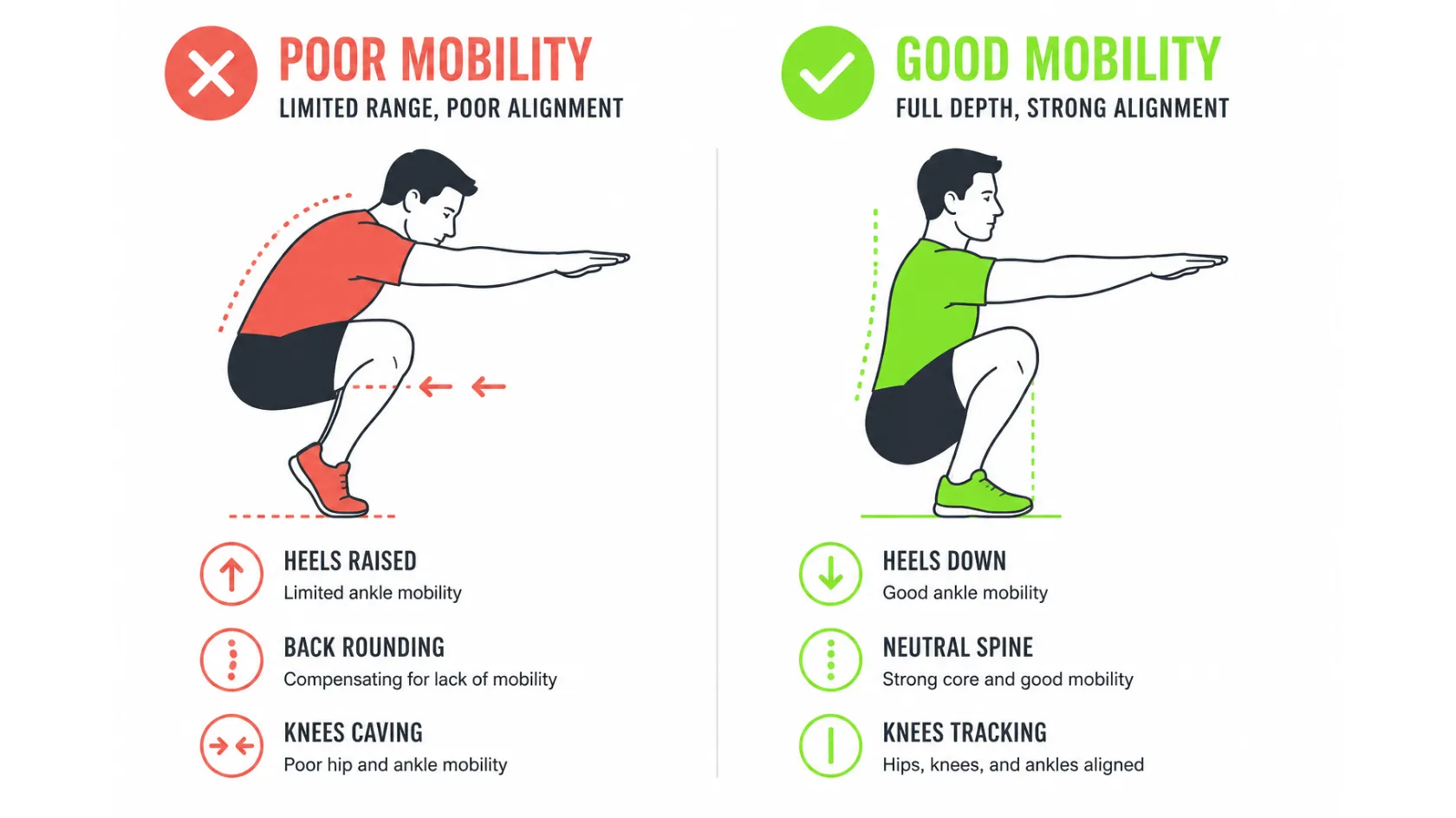
If you can't get into a full squat position, you're not recruiting your glutes and hamstrings properly — you're compensating with your lower back. If your thoracic spine is locked up, your bench press is limited by your shoulder positioning, not your chest strength. Mobility restrictions create movement compensations that cap your performance regardless of how hard you train.
Injury risk stacks up silently
Most gym injuries don't happen from one bad rep. They happen because a restricted joint forces a neighbouring joint to compensate — for months — until something gives. Tight hip flexors → excessive lumbar extension → lower back pain. Limited thoracic rotation → shoulder impingement. It's always connected.
Recovery takes longer
Muscles that are chronically shortened and tight don't flush blood as efficiently. Mobility work improves circulation to the tissues you've just trained, speeds up waste product removal, and reduces the stiffness you feel 24–48 hours after a hard session. This is why a proper recovery routine always includes some form of movement — not just sleep and protein.
Should You Stretch Before or After a Workout?
This is where most people get it wrong. And it's worth getting right — because the wrong approach can actually hurt your performance.
The short answer: dynamic mobility before, static stretching after.
Before your workout: dynamic warm-up only
Static stretching — holding a muscle in a lengthened position for 30–60 seconds — before lifting has been shown in multiple studies to temporarily reduce force output and power. You're essentially telling your nervous system to inhibit the muscle before you need it to fire hard. Not ideal.
What you want pre-workout is dynamic mobility work: controlled movements through full ranges of motion that increase blood flow, elevate muscle temperature, and activate the joints you're about to load. Think leg swings, hip circles, deep bodyweight squats — movement, not static holds.
After your workout: now you can hold
Post-workout is the ideal time for static stretching. Your muscles are warm, your nervous system is less reactive, and your tissues are more pliable. This is when you'll get the most ROM improvement from held stretches. It's also when you'll benefit most from the recovery effects — blood flow, tension release, parasympathetic activation.
An added bonus: static stretching after training appears to reduce DOMS (delayed onset muscle soreness) — not dramatically, but meaningfully.
The Complete Routine: Warm-Up + Cool-Down
Here's exactly what to do. These aren't random stretches — each one is chosen to address the most common mobility restrictions for people who train.

Pre-workout dynamic warm-up (8–10 min)
Do each movement for the listed reps. No rushing — controlled movement through the full range is the point.
Post-workout static stretching (10–12 min)
Hold each stretch for 30–60 seconds per side. Breathe slowly. Don't force the range — ease into it on each exhale.
The 4 Tight Spots Most People Have (And How to Fix Them)
Not all tightness is created equal. These four areas affect the most people, cause the most compensations in training, and respond well to consistent work.
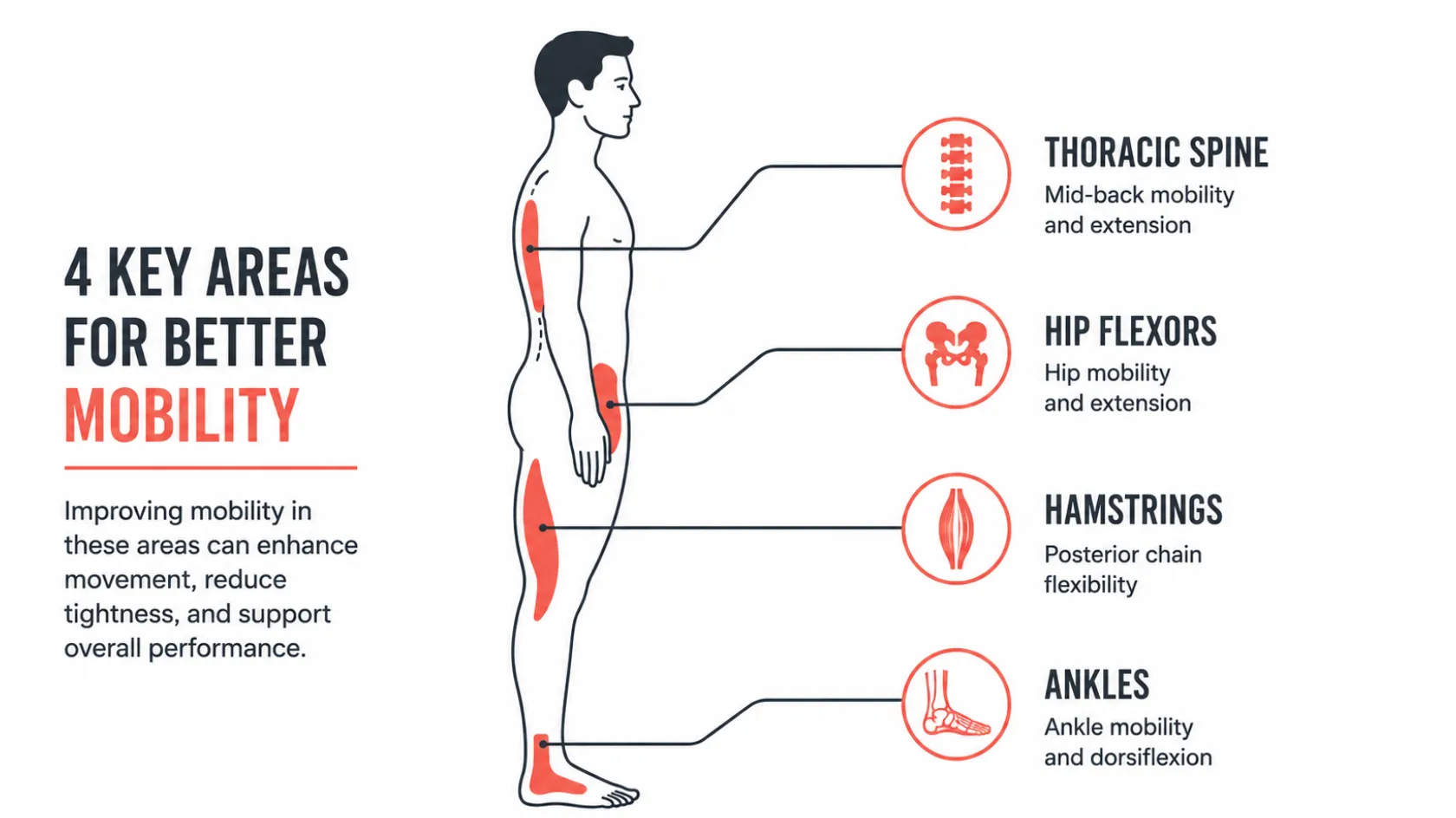
| Area | Why it gets tight | Training impact | Best fix |
|---|---|---|---|
| Hip flexors Psoas / iliacus |
Sitting for long periods. Every desk job ever. | Anterior pelvic tilt, reduced squat depth, lower back pain during deadlifts | Kneeling hip flexor stretch + couch stretch (daily) |
| Thoracic spine Mid-back |
Slouched posture, excessive phone use, poor sitting habits | Limits overhead press range, forces lumbar compensation, restricts bench positioning | Thread-the-needle, foam roller thoracic extension (post-workout) |
| Hamstrings Posterior chain |
Undertrained relative to quads; also shortened by sitting | Posterior pelvic tuck at squat bottom ("butt wink"), limits hip hinge range | Seated or standing hamstring stretch, RDL tempo work |
| Ankles Dorsiflexion |
Old sprains, improper footwear, lack of ankle work | Heels lift in squats, knees compensate forward, can't achieve depth without a wedge | Ankle circles, banded dorsiflexion, deep squat holds with heels flat |
If you've been dealing with any of the "training impact" issues in that table and couldn't figure out why, now you know. These restrictions are the root cause — not weak muscles, not bad genetics, not your programming.
How to Add Mobility Work to Your Daily Life
Here's the trap most people fall into: they treat mobility as a separate workout they need to find time for. Then they never find time, and it never gets done.
The better approach is to make it opportunistic. Small doses, frequently — not one big session once a week.
The desk-break habit
Every 60–90 minutes of sitting: stand up, do 5 hip circles per side, 10 leg swings, and reach overhead with a deep breath. Takes 90 seconds. Directly counteracts the hip flexor tightening from sitting.
The morning floor routine
5 minutes before you leave your bedroom. Three exercises: cat-cow (10 reps, spinal mobility), pigeon pose (30s per side), and a deep squat hold (30s, heels flat). That's it. Do it every morning for a month and notice the difference in your squat and hip mobility.
Pre-bed stretching
Static stretching activates the parasympathetic nervous system — it genuinely helps you wind down. A 5-minute stretch before sleep (hip flexors, hamstrings, and child's pose) improves both mobility gains and sleep quality. Two wins.

Mobility work isn't a bonus for people who have extra time. It's the infrastructure everything else sits on. When your joints move properly, your technique improves, your strength improves, and your injury risk drops. The 10 minutes you spend on it after each session pays back more than almost anything else you could add to your routine.
The Bottom Line
Mobility and flexibility are not the same thing. Mobility is active control — and that's what training actually demands. Static stretching before lifting hurts performance; dynamic warm-ups before and static stretches after is the correct order.
Focus your mobility work on the four biggest limiting areas: hip flexors, thoracic spine, hamstrings, and ankles. Eight to ten minutes of dynamic warm-up before your session, ten to twelve minutes of static stretching after, and small daily habits throughout the rest of your day.
Do it consistently for six weeks and you'll move better, lift more, and feel the difference in every session. It's not glamorous — but neither is progressive overload, and that's the whole point. The unglamorous stuff works.
This article is based on peer-reviewed research and established exercise science. Sources are listed for transparency and verification.
- Behm DG, Blazevich AJ, Kay AD, McHugh M. (2016). Acute effects of muscle stretching on physical performance, range of motion, and injury incidence in healthy active individuals: a systematic review. Applied Physiology, Nutrition, and Metabolism, 41(1), 1–11. pubmed.ncbi.nlm.nih.gov
- Simic L, Sarabon N, Markovic G. (2013). Does pre-exercise static stretching inhibit maximal muscular performance? A meta-analytical review. Scandinavian Journal of Medicine & Science in Sports, 23(2), 131–148. pubmed.ncbi.nlm.nih.gov
- Hartig DE, Henderson JM. (1999). Increasing hamstring flexibility decreases lower extremity overuse injuries in military basic trainees. The American Journal of Sports Medicine, 27(2), 173–176. pubmed.ncbi.nlm.nih.gov
- Holt BW, Lambourne K. (2008). The impact of different warm-up protocols on vertical jump performance in male collegiate athletes. Journal of Strength and Conditioning Research, 22(1), 226–229. pubmed.ncbi.nlm.nih.gov
- Fong Yan A, Cobley S, Chan C, et al. (2018). The effectiveness of yoga in modifying risk factors for cardiovascular disease and metabolic syndrome. European Journal of Preventive Cardiology, 25(14), 1465–1474. (cited for parasympathetic activation from stretching) pubmed.ncbi.nlm.nih.gov
- Behm DG, Chaouachi A. (2011). A review of the acute effects of static and dynamic stretching on performance. European Journal of Applied Physiology, 111(11), 2633–2651. pubmed.ncbi.nlm.nih.gov
Younes is the founder and content creator behind SpotyFlex — a fitness blog built on the principle that real training knowledge shouldn't be buried under bro-science and filler. He covers strength training, nutrition, and recovery with a focus on what the research actually supports. When he's not writing or building the platform, he's in the gym applying it.

/1.webp)
